
Wayne County Warrant Checks
Indiana has no public database covering every arrest warrant. Wayne County fills part of that gap. The sheriff runs a current roster plus an older lookup, and MyCase offers public case summaries rather than a warrant-only search. The Clerk takes record requests too. Still, the issuing court answers the real question: is a warrant active now? Bring a full name, an approximate birth date, and any case or citation number. And be careful, because a similar name alone may not be the right person. Treat each online hit as a lead worth confirming.
- Review the sheriff Warrants page, noting that it gives no completeness or update promise.
- Search MyCase by name or cause number for a nonconfidential case and docket events.
- Check Hagerstown Town Court, Fountain City’s described Municipal Court, or Superior III for a Richmond ordinance case when applicable.
- Call the sheriff at 765-973-9393, Clerk at 765-973-9220, or issuing court; alternatively submit a particularized records request.
- If a warrant may concern you, consult an attorney before arranging an appearance, bond, or voluntary surrender.
Two Sheriff Interfaces, Different Limits
The Wayne County sheriff's legacy lookup still shows date, name, street, city, and state fields on a page last revised April 4, 2016, so verify anything it returns.
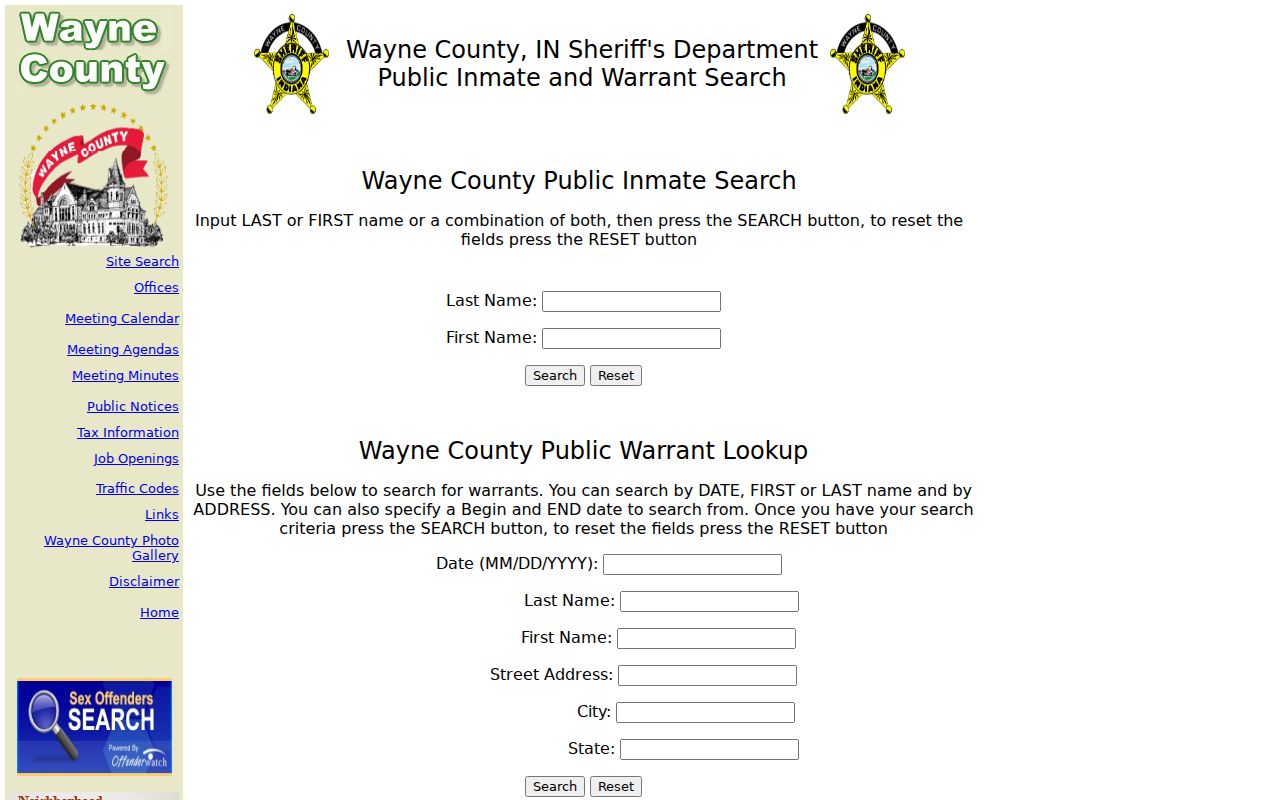
That older layout does not reflect current status. The Wayne County current sheriff page instead filters a curated visual roster.
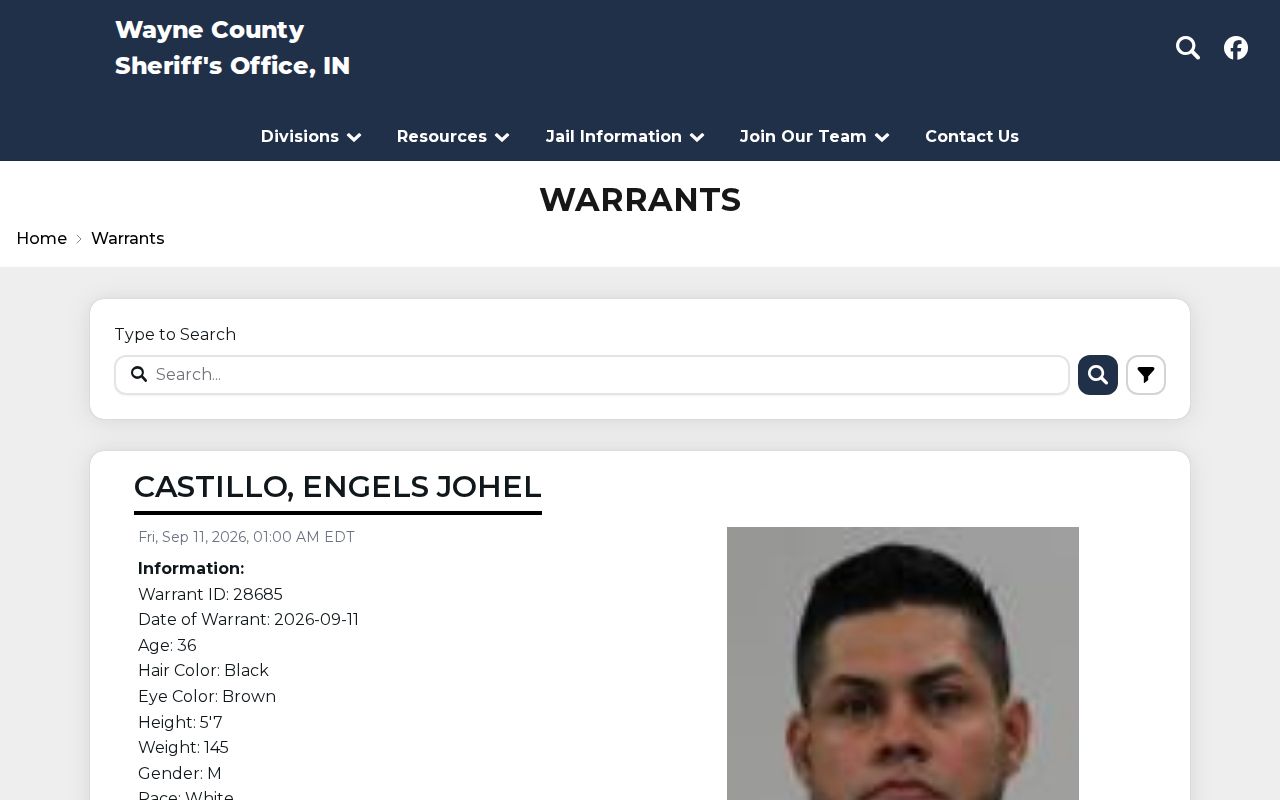
The Wayne County roster publishes no status legend, court coverage, completeness statement, or refresh schedule. So confirm any match with the issuing court, since an empty result does not prove no warrant exists.
| Channel | Controls | Limit |
|---|---|---|
| Legacy | Date, name, address | Old, unconfirmed interface |
| Current sheriff | Free-text filter | Curated cards |
| MyCase | Case, name, court, dates | Not all warrants |
| Clerk request | Record, delivery, certification | Not instant status |
Warrants in Wayne County: The Main Types
Wayne County sources call them bench warrants, arrest warrants, or warrants after a failure to appear, never capias. Each type carries its own trigger and custodian.
| Warrant Type | How It Arises | Who Issues It |
|---|---|---|
| Arrest | Charging document and probable cause | Judge or court |
| Bench | Missed appearance or violation | Case judge |
| Search | Supported request to search | Judicial officer |
| FTA | Failure to attend required event | Requiring court |
| Traffic/ordinance | Missed date or unresolved matter | Superior III or local court |
A Wayne County search warrant authorizes a search, not an arrest, and an investigative-request file tied to it may be restricted from public view.
MyCase Is Not a Warrant List
MyCase sometimes surfaces a warrant event inside a public case summary for Wayne County. The site's tabs and filters help you narrow things down. Try the case, name, attorney, court, status, and date controls. The official help page warns that online information is not the official record, so omissions happen. A missing result can mean a case is confidential, old, or simply unavailable there. The public court portal offers separate case-search and traffic-payment routes of its own. Neither portal works as a statewide all-warrants database, and paying a traffic balance does not prove recall of a separate warrant. Only the issuing court can confirm that.
Wayne County Warrant Records: What They Show
A Wayne County court file can carry more warrant detail than the sheriff roster shows. Note the source date, then confirm the newest docket event.
| Warrant or Cause Number | A court identifier such as 89D03-YYMM-CM-#####; format varies. |
|---|---|
| Subject | The named or described person; identity needs verification. |
| Charge | An allegation or underlying matter, not a conviction. |
| Issuing Court | Circuit, Superior 1, 2, 3, or a local court. |
| Bond | An amount or instruction subject to change. |
| Status | Issue, service, recall, or withdrawal event requiring current confirmation. |
The Richmond Records Triangle
The county directory maps a tidy triangle in Wayne County: courts and the Clerk at 301 East Main, the sheriff at 200 East Main, and administration at 401 East Main. Close doors do not merge duties, though. The Clerk supplies court records. Judges control warrants. The sheriff serves process and publishes selected information. Ask the Clerk for a certified order and the sheriff about publication or service.
Wayne County Warrants: Who Issues, Who Serves
In Wayne County, Circuit and Superior Courts 1, 2, and 3 issue warrants. Misdemeanors and certain Level 6 or driving matters generally route to Superior III, while other felony filings spread across Circuit, Superior I, and Superior II. Hagerstown Town Court adds a local layer. The courts authorize, the Clerk maintains, and the sheriff or another officer serves. The sheriff's contact page lists its office route.
The contact can route an enforcement question but cannot replace the issuing court’s status.
Wayne County Sheriff’s Office
200 East Main Street
Richmond, IN 47374
765-973-9393
Monday through Friday, 8:00 a.m. to 5:00 p.m.
Warrant Wednesday Is a Public-Help Program
A Wayne County sheriff's May 13, 2026 post asks for tips through 765-973-9355, its website, and its phone app.
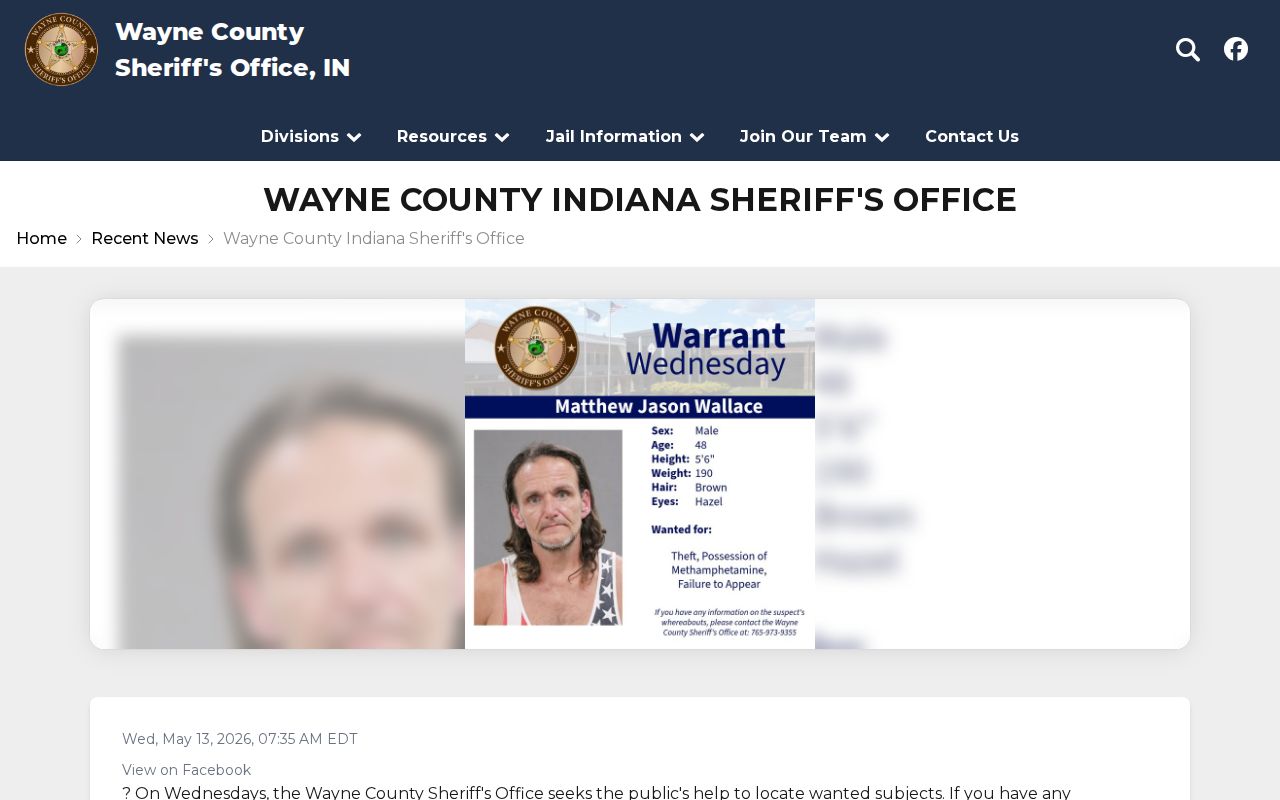
Warrant Wednesday is neither amnesty nor a complete Wayne County warrant database. Never confront anyone yourself; call 911 for emergencies and leave the rest to the sheriff.
Handling a Wayne County Warrant
Start by identifying the issuing Wayne County court and cause number. Ask about current status, the trigger, any hearing, bond, payment, and whether counsel or a motion is required. An Indiana attorney can discuss voluntary surrender, posting bond, or requesting recall. The county publishes no standard recall fee. Get case-specific instructions instead.
Important: Speak with an attorney before appearing or surrendering. Driving or encountering police with an active warrant can result in arrest.
Paying a Wayne County traffic or ordinance balance may cover money due without recalling a separate warrant. Keep receipts, hearing notices, bond documents, and any recall order.
Requesting a Clerk Record
The Wayne County Clerk's instructions cover electronic requests and delivery. Name the court, cause number, record, dates, and delivery method. Copies run $1 per page and certification adds $3, with certified records available by mail or pickup only. A records request is not recall and not legal advice. The traffic page lists payment methods and deadlines. Follow the citation and court directions, and confirm any license consequence or warrant event separately.
Warrant Record Access Under Indiana Law
APRA governs Wayne County agency records, while court records also follow access rules, sealing orders, and statutes. The Rule 5 text covers confidential cases and investigative requests. That is why a case, an arrest-warrant request, and a standalone search-warrant file can differ in visibility.
Key Rules:
IC 35-33-2-1 and 2 authorize arrest warrants and their written elements.
IC 5-14-3-3 and 4 provide APRA’s request baseline and exemptions.
Court Record Rule 5 addresses confidential cases, investigative requests, and temporary exclusion.
IC 31-39-1-2 guidance explains general juvenile confidentiality.
Richmond Tickets Can Reach Superior III
Richmond's instructions separate city payment from court prosecution. An unpaid ticket can reach Superior III, which sets a hearing-day payment cutoff. Paying the City Clerk is not the same as county court custody. Richmond Police posts contact information but offers no warrant search. For an old ticket, check MyCase and ask Superior III whether a Wayne County warrant or hearing remains.
Town Routes Differ
Town routes across Wayne County differ quite a bit. Hagerstown Town Court appears in the state directory. Fountain City describes a Municipal Court but does not currently list it there, while its court page exists separately. Centerville posts 24-hour police coverage on its police page, but the town runs no separate court or warrant portal. Police service is not court custody. Call ahead to confirm Fountain City's operating route before you visit; its police page gives marshal contacts. A marshal can route service questions, but the responsible court confirms judicial status.
Wayne Warrant Terms
Wayne County warrant terms shift from office to office. The sheriff page publishes no definition of “active,” and one source can lag behind another. When staff confirm a record, use the court’s own language rather than the wording on a roster card or docket entry.
- Bench warrant
- A court arrest order, often after nonappearance.
- Cause number
- The case identifier used to confirm a docket.
- FTA
- Failure to appear, a possible warrant trigger.
- MyCase
- Indiana public case search, not an all-warrants list.
- Recall
- Court action ending or changing a warrant.
- Search warrant
- Authority to search, sometimes restricted as an investigative request.
- Status
- Current legal condition verified with the custodian.
- Warrant Wednesday
- A sheriff communication, not proof of guilt or completeness.
City Warrant Records in Wayne County
Wayne County’s five largest incorporated places in the 2020 Census are Richmond, Centerville, Cambridge City, Hagerstown, and Fountain City, in that order; the Census table backs the list. Local officers may serve process while court custody varies. Richmond matters can reach Superior III. Hagerstown runs a Town Court, and Fountain City describes a Municipal Court.
Richmond Warrant Records
35,720 · Richmond Police and Superior III route
Centerville Warrant Records
2,552 · Town police and county court verification
Cambridge City Warrant Records
1,751 · Police service and county records route
Hagerstown Warrant Records
1,681 · Town marshal and Town Court
Fountain City Warrant Records
714 · Marshal and described Municipal Court
Written Requests Fill Gaps
A cause number beats a name every time. Two people can share one, and an old address only muddies the search. Without the number, give the court, the rough filing period, the record category, and enough detail that staff can find the file without an open-ended hunt. Wayne County keeps offline routes open because its online systems each do a different job. The Clerk answers file and certified-copy questions. The court handles scheduling and judicial instructions. The sheriff takes calls about its roster and service. None of that cancels a warrant by itself. A focused written request names the agency, court, record, dates, and delivery method. Fountain City’s request page accepts a City Hall form, hand delivery, mail, email, fax, or a letter. No fee or processing schedule is stated, and hours vary. Town requests reach town-held material only; a county judicial order stays with the Wayne County Clerk or court, subject to confidentiality. Then weigh the answer against the question you asked. A copy of an issued warrant proves an order existed, yet it can omit later service, recall, withdrawal, bond, or a new hearing. Ask for the chronological case summary or the most recent order when those events matter. Certification authenticates a document; it does not turn an old order into proof of current status.
Restricted records open a different gap. Sealed cases, protected identifiers, juvenile material, and qualifying investigative requests stay governed by statutes and court rules, so a Wayne County agency may release the public portion, withhold protected content, or point you to a judicial custodian. A partial response or a missing online document does not prove the record never existed. Keep an audit trail as you go: the official URL, the date you accessed it, the spelling you searched, the cause or citation number, the office contacted, and the response received. Do not circulate a sheriff roster card or photograph as proof of identity. Similar names and stale pages cause real mistakes. If a Wayne County warrant may concern you, legal advice is the safest bridge between verifying the record and planning an appearance, bond, payment, or motion. After an apparent resolution, collect the payment receipts, any bond record, a new hearing notice, and an entry or signed order showing recall or withdrawal. Then confirm the latest docket status with the court instead of assuming every public page updates at once. The dependable endpoint is a documented court outcome, not a web card that vanished from a filtered list. Picking the right custodian makes any request sharper. A judicial order, docket entry, bond record, or certified case copy belongs on the court side. A sheriff publication, service question, or tip belongs on the enforcement side. A city ticket receipt may sit with a municipal office even when the later prosecution is recorded in Wayne County Superior III, so one broad blast to every office can return conflicting answers because each office is describing a different record in the same sequence.
Ask narrow status questions in order: which court issued the order, which cause number controls, whether the warrant remains executable, whether service or recall has been entered, what hearing is scheduled, and what document proves the answer. Staff can give procedural information, but they cannot advise a plea or predict a judge. Counsel is the right source for strategy and for weighing the risk of appearing in person. A no-result answer needs context too. The sheriff’s current page may omit courts or records because its coverage is unstated. MyCase may leave out a restricted or older matter. A town site may describe a court without a searchable docket, and the legacy Wayne County form may reflect an earlier data system. Working the fallback chain, from web source to phone, court, Clerk, and written request, is normal verification, not proof that officials disagree. One more line matters. Indiana’s Electronic Tax Warrant system serves tax administration, not a public criminal warrant lookup, and search-warrant requests can carry special confidentiality as investigative material. Neither substitutes for the Wayne County sheriff and court channels that confirm an arrest, bench, failure-to-appear, traffic, or ordinance matter. Before acting, verify phone numbers, office hours, payment instructions, and court assignments on the linked official pages, because operational details can change after publication.